
Introduction
Continuous manufacturing has emerged as a transformative strategy in pharmaceutical production, offering significant advantages over traditional batch processing. These benefits include improved process control, reduced batch-to-batch variability, smaller equipment footprints, and seamless integration with automation, real-time analytics, and model predictive control systems. In particular, integrated continuous manufacturing (ICM) which links multiple unit operations within a single, uninterrupted equipment train further amplifies these advantages by eliminating the need for intermediate workups, holding steps, and time-consuming in process quality control testing. Instead, process analytical technologies (PAT) enable real-time product quality assurance.
As a result, ICM supports more agile and responsive manufacturing, which is particularly valuable for meeting fluctuating market demand or responding to public health emergencies. Recent global supply chain disruptions, including drug shortages exacerbated during the COVID-19 pandemic, have highlighted the vulnerability of traditional pharmaceutical supply chains and the urgent need for domestic, flexible manufacturing capabilities. During the pandemic, the number of active drug shortages in the U.S. reached into the hundreds, prompting regulatory and industrial interest in reshoring essential medicines.
ICM has gained increasing traction in the drug product domain (e.g., tableting and coating), but its adoption for drug substance manufacturing has also been accelerating. Recent examples demonstrate the feasibility of continuous production of complex active pharmaceutical ingredients (APIs) directly from raw materials, setting the stage for truly end-to-end continuous manufacturing platforms. These integrated systems not only streamline development and scale-up, but also enable unprecedented control over process performance, cost, and quality. A milestone in drug substance continuous manufacturing is the CGMP synthesis of prexasertib monolactate monohydrate by Cole et al., who demonstrated a fully integrated, eight-step continuous process to produce 24 kg of API for clinical use.
This work underscores the feasibility of end-to-end continuous platforms for clinical and commercial pharmaceutical production. Rocuronium bromide (Roc-Br) is a steroidal, nondepolarizing neuromuscular blocking agent widely used to facilitate tracheal intubation and muscle relaxation during surgical procedures and mechanical ventilation. Its use surged during the COVID-19 pandemic due to increased demand for ventilator support, leading to shortages that were formally recognized by the U.S. Food and Drug Administration (FDA).
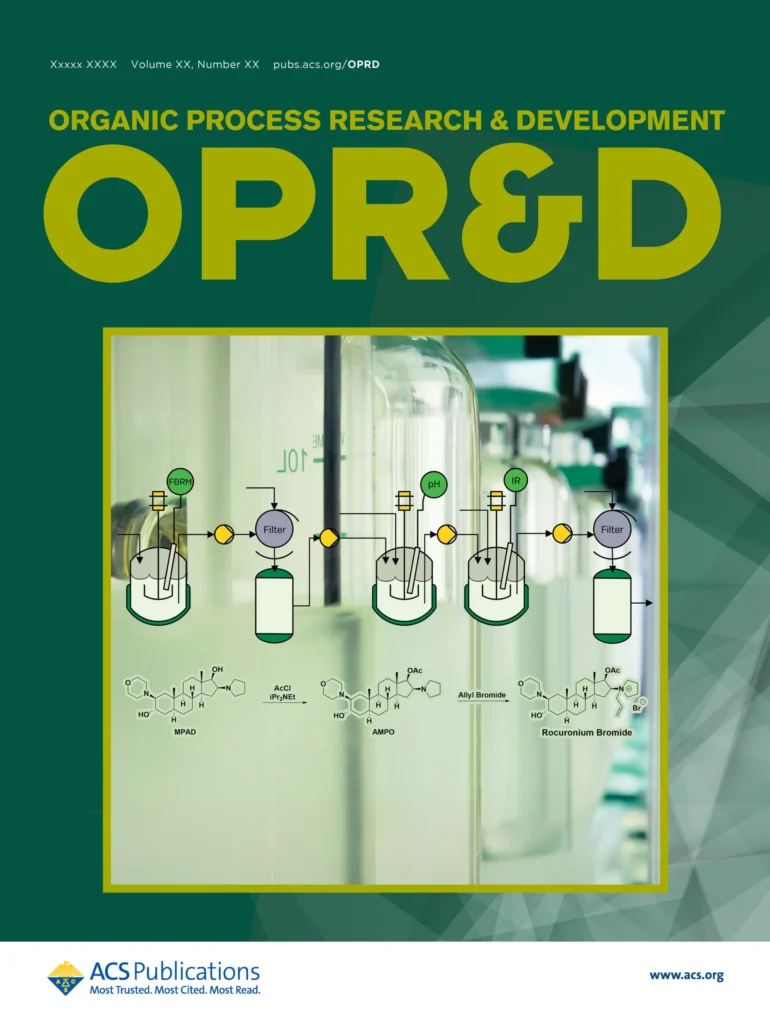
In response, and as part of the U.S. government’s Project Warp Speed initiative, we targeted the development of a continuous manufacturing process for Roc-Br to enhance domestic production capacity and supply chain resilience. Several multistep batch synthesis routes for Roc-Br have been reported in the literature. However, the complexity of its structure and the number of associated unit operations present significant challenges for fully integrated continuous manufacturing. These challenges include managing solid−liquid transitions, solvent swaps, purification steps, and reaction condition sensitivities across multiple stages. To address these issues pragmatically, we selected MPAD a stable, commercially available prepenultimate intermediate as the starting point for our continuous synthesis. This allowed us to focus on the final two chemical transformations: (1) the acetylation of MPAD to form the intermediate AMPO and (2) the subsequent N-alkylation with allyl bromide to form Roc-Br. This decision enabled us to focus on the final two steps of the synthesis, which encompass the following unit operations: Step 1 acetylation reaction, distillation, crystallization, filtration, transfer to Step 2, alkylation reaction, crystallization, filtration, and the final drying step.
Drying is not required after Step 1, since the filtered wet cake is directly transferred to Step 2 for the subsequent reaction, in the same solvent as Step 1. This development effort follows a structured three-phase methodology: Phase 1 focuses on converting individual unit operations from batch to continuous mode; Phase 2 involves the integration of all unit operations into a fully connected continuous pilot line; and Phase 3 targets CGMP implementation and commercialization of the end-to-end continuous process.
This manuscript is the first in a two-part series describing the Phase 1 development and implementation of a continuous manufacturing process for Roc-Br. Part 1 of this 2-part series summarized the key results from the Step 1 unit operations including the acetylation reaction, extractive workup and crystallization. Step 1 filtration was not included in the current study. Throughout this development, multiple PAT tools such as ReactIR and FBRM were employed to provide real-time monitoring and process understanding. These results lay the foundation for seamless integration with the Step 2 alkylation and final crystallization of Roc-Br, as will be discussed in Part 2 of this series. Ultimately, this work serves as a proof of concept for applying ICM principles to the synthesis of structurally complex and supply critical injectable APIs like Roc-Br.
Abstract
Rocuronium bromide was a critical medicine during the COVID-19 pandemic but experienced shortages due to global supply chain disruptions. To enhance supply chain resiliency and enable rapid response to future demand surges, we converted the final two steps of its synthesis to continuous processing, enabling a shorter, more responsive manufacturing lead time. This first part of a two-part study focuses on the development of the Step 1 acetylation of MPAD to form AMPO and the associated downstream operations, including continuous workup and crystallization. Through batch and flow screening studies, we identified N,N-diisopropylethylamine (DIPEA) and dichloromethane (DCM) as optimal base and solvent, respectively, and determined 1.11–1.13 equiv of acetyl chloride (AcCl) in 10 volumes of solvent to be optimal for minimizing impurities. Kinetic profiling and dynamic flow experiments enabled selection of a ∼2 min residence time, and the process was successfully scaled using a CSTR-PFR configuration. A membrane-based liquid–liquid separator was implemented for continuous workup, and the crystallization of AMPO was optimized using solubility, metastable zone width (MSZW), and impurity rejection studies. Continuous crystallization using a two-stage MSMPR system yielded high-purity AMPO with consistent particle size and demonstrated robust, steady-state operation. The key outcomes of this study establish a strong foundation for realizing fully integrated end-to-end continuous manufacturing of rocuronium bromide.