
Introduction
The pharmaceutical industry has increasingly embraced continuous manufacturing as a transformative approach to improve efficiency, quality, and responsiveness in drug production. Compared to traditional batch operations, continuous processes offer tighter control over reaction conditions, reduced material hold-up, and greater flexibility in scaling. The integration of multiple unit operations (e.g., reaction, crystallization, filtration, drying, etc.) within a continuous framework—an approach often referred to as Integrated Continuous Manufacturing (ICM)—enables the real-time control of critical process parameters and quality attributes.
An important milestone in drug substance continuous manufacturing is the kilogram-scale synthesis of prexasertib monolactate monohydrate reported by Cole and co-workers. This paradigm minimizes the need for intermediate testing and manual interventions, supporting parametric release and facilitating just-in-time production. ICM also enhances resilience against supply chain disruptions and reduces the environmental footprint by improving process mass intensity and solvent recovery. These attributes are particularly beneficial for the manufacturing of active pharmaceutical ingredients (APIs), especially those requiring stringent control over reaction selectivity and impurity profiles.
Rocuronium bromide (Roc-Br), a steroidal neuromuscular blocking agent used for rapid sequence intubation and maintenance of muscle relaxation during surgery, has become a key therapeutic in critical care settings. Its demand surged during the COVID-19 pandemic, where it played a crucial role in enabling mechanical ventilation in patients requiring respiratory support. Despite its importance, the drug experienced global shortages, driven in part by a reliance on batch manufacturing routes with extended lead times and fragmented global supply chains. As a result, there is an urgent need to establish more robust, scalable, and responsive manufacturing strategies that can adapt to fluctuating demand and mitigate risk.
The synthesis of Roc-Br comprises multiple complex transformations, each with specific requirements for conversion efficiency, impurity control, and crystallization performance. The final step of the synthesis—the N-alkylation of an acetylated intermediate (AMPO) to produce Roc-Br—poses several challenges, including slow kinetics, high reagent requirements, and extensive downstream processing. Traditional batch procedures involve multiple unit operations, such as solvent exchange, aqueous extractions, charcoal treatments, and distillation, all of which contribute to long cycle times and increased solvent waste. Transitioning this chemistry to a continuous platform demands a strategic reevaluation of reaction conditions, reactor design, and crystallization protocols.
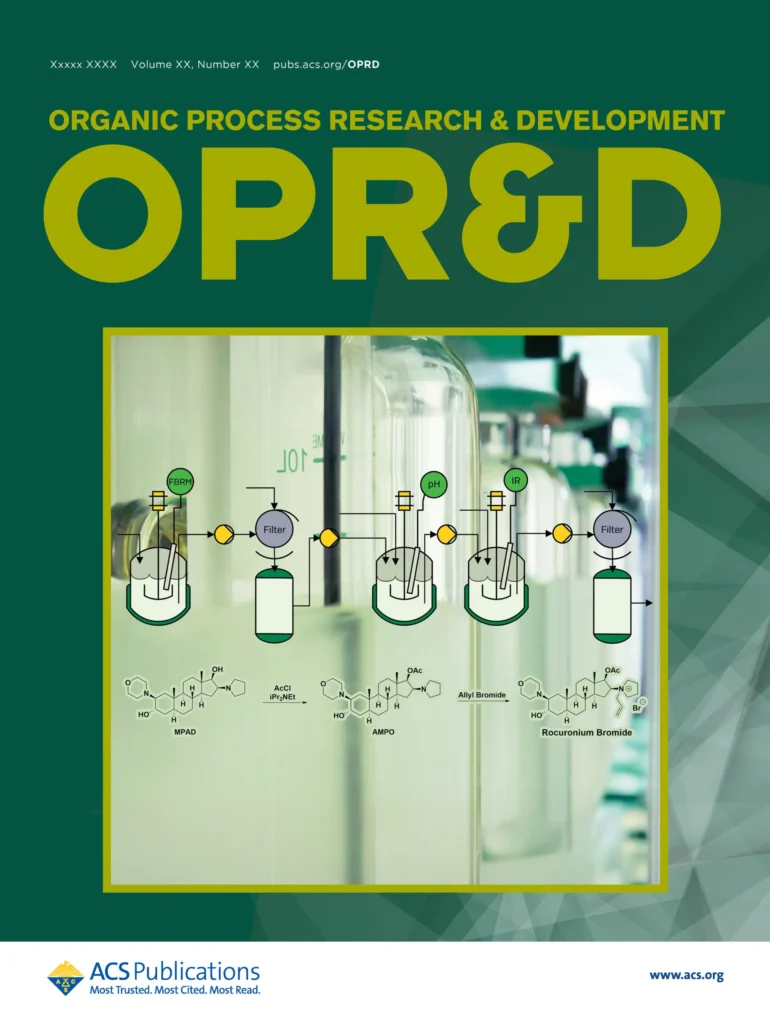
This manuscript presents Part 2 of a two-part series detailing the development toward an ICM process for Roc-Br. Building upon the foundational work described in Part 1, which focused on Step 1 acetylation, extraction workup, and crystallization, this installment concentrates on the conversion of AMPO to Roc-Br. Specifically, we describe the development of a continuous N-alkylation process using a Continuous Stirred-Tank Reactor (CSTR) cascade and the optimization of post-reaction crystallization to deliver high-purity Roc-Br in crystalline form. The scope includes kinetic modeling of the N-alkylation reaction, implementation of in-line process analytical technologies (PAT) such as ReactIR and conductivity monitoring, and systematic evaluation of antisolvent crystallization strategies using various solvent systems.
Altogether, this study demonstrates the feasibility of converting the final synthetic steps of Roc-Br to a continuous process, reducing unit operations and improving process throughput. While this work does not include continuous crystallization or final filtration and drying of Roc-Br, the groundwork laid here paves the way for further integration with upstream steps described in Part 1. Ultimately, the methodologies developed in this series exemplify how ICM can be applied to the synthesis of structurally complex and supply-critical APIs, with the goal of enabling more agile and resilient pharmaceutical manufacturing in response to global health needs.
Abstract
Rocuronium bromide, a neuromuscular blocking agent critical to anesthesia and emergency care, experienced severe shortages during the COVID-19 pandemic due to fragmented global supply chains and limitations of traditional batch manufacturing. To enhance supply chain resilience and responsiveness, this Part 2 manuscript details the development and optimization of the Step 2 unit operations, including the N-alkylation, continuous reaction, and crystallization. Through kinetic modeling and real-time monitoring using ReactIR and conductivity, the Step 2 N-alkylation was optimized to reduce reaction time and reagent usage. A five-stage CSTR cascade was implemented, achieving >98% rocuronium bromide purity with steady-state performance and minimal residual starting material. For crystallization, extensive solubility and solvent screening identified methyl propyl ketone (MPK) as the most effective antisolvent, enabling high-purity rocuronium bromide recovery with yields up to 94%. The process was successfully scaled to a 500 mL CSTR, and in-line particle analysis confirmed robust crystal growth dynamics. These advancements demonstrate the viability of transitioning small molecule API synthesis into continuous operation while maintaining control over reaction and solid-state quality. The work presented here makes significant progress on the second half of the process (particularly in addressing the low assay challenge), positioning this work for future integration into an end-to-end continuous manufacturing platform for rocuronium bromide.